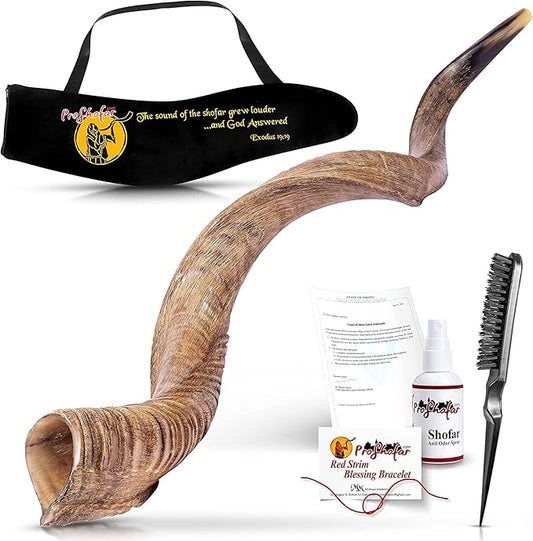
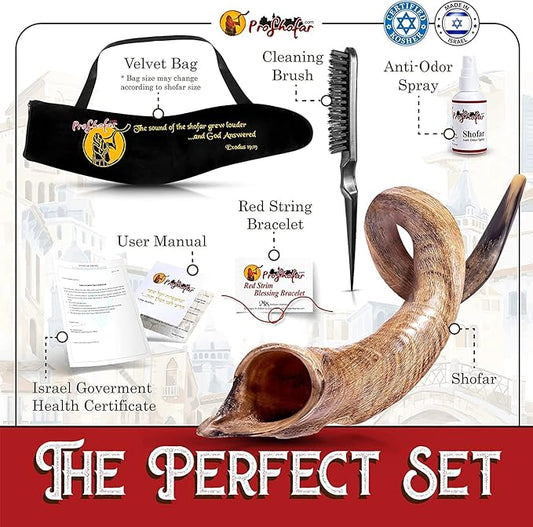


Behind every shofar we send out is a person — and a family. Here's the story of Avi Mishaan, the craftsman behind Hallel Israel.
A family calling, three generations deep
The Mishaan family has been working with shofars since 1960. Avi is the third generation to carry it forward — but for him, it was never just the family business. He fell in love with it as a child, drawn to the way it "touches your body, your inside, your spirit."
Avi's path wasn't a straight line into the workshop, though. He grew up in Tel Aviv, served in an elite combat unit in the IDF, and came through experiences that stayed with him long after his service ended. It was in the years afterward, working through what he'd carried home from the army, that he found his way back to the world of the shofar — and realized it wasn't simply a trade. It was a calling.
"It didn't make economic sense," he says. "You invest your spirit in connection with G-d."
From nature to sacred instrument
Every shofar starts as part of an animal's life — a horn that would otherwise be discarded. Avi describes the craft almost like reclamation: taking what nature leaves behind and, through skill and intention, turning it into something holy. A horn becomes an instrument capable of carrying prayer.
He connects this directly to one of Judaism's defining moments — the Binding of Isaac, where a ram appears in Isaac's place and gives the shofar its lasting meaning. From that moment on, Avi sees the shofar as a line of communication between people and G-d, used across history by kings, prophets, and armies, and still gathering communities around its sound today.
He's fond of pointing out that the word shofar comes from the Hebrew root l'shaper — to improve. "It's a tool to improve us," he says. And then, almost as a personal creed: to lead isn't only to have a shofar. It's to be one — to be in communication with people, projecting something uplifting out into the world.
Not a shelf piece
Avi is emphatic that a shofar shouldn't sit boxed up until Rosh Hashanah. It's meant to be picked up, learned, and used. "The shofar is different from the iPad. It connects us," he says. He encourages everyone — customers included — to try blowing it themselves, calling it simply "the best thing."
Why this matters for Rosh Hashanah
For Avi, the shofar's role in the holiday is practical and spiritual at once: its sound helps open the gates of heaven at the start of the year, and its final blast at the close of Yom Kippur seals them again. A breath becomes a prayer.
Connected to Lev HaOlam
This year marks the second time Avi's workshop has partnered with the Lev HaOlam family to send shofars to Jewish homes around the world — a partnership that also helped carry the business through a difficult stretch for Israeli tourism during the war. "The order saved my business," he says plainly. "It's a breath of air."
Want to learn how to blow your own shofar, or how to choose the right one? See our Shofar Buyer's Guide and Beginner's Guide to Blowing a Shofar.
Tags:

