



Coming just five days after Yom Kippur, Sukkot is one of the most joyful holidays in the Jewish calendar — a seven-day festival that pulls families literally out of their homes and into small, temporary shelters open to the sky. It's a strange and beautiful practice, and one whose meaning goes deeper than it first appears.
What Sukkot commemorates
Sukkot has two layers of meaning that sit alongside each other. The first is agricultural: it marks the end of the harvest season in the Land of Israel, a time of gratitude for the year's food and abundance. That's why it's sometimes called Chag HaAsif, the Festival of Ingathering.
The second layer is historical. The Torah instructs the Jewish people to dwell in temporary shelters for seven days as a reminder of the forty years spent wandering in the desert after the Exodus from Egypt, when the Israelites lived in impermanent booths under God's protection. Sitting in a fragile shelter each year is a way of remembering that ultimate security doesn't come from walls and roofs.
The sukkah itself
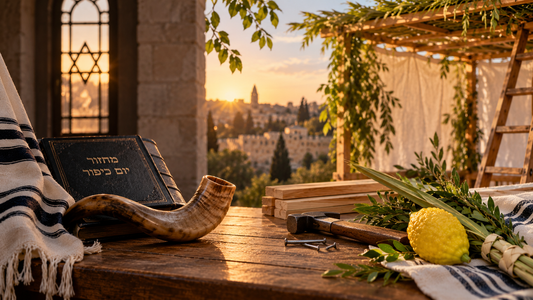
A sukkah is a temporary structure built specifically for the holiday. It has to meet a few requirements: at least three walls, a roof made of natural materials (typically bamboo, palm fronds, or wooden slats — called schach) that provides more shade than sunlight but through which stars can still be seen at night.
Families eat meals in the sukkah for the full week, and some traditions include sleeping there too. It's often decorated with hanging fruits, colorful chains, children's artwork, and framed prints or posters — something between a dining room and a small piece of celebration space.
The four species (Arba Minim)
Alongside the sukkah, Sukkot has a second central ritual: the taking of the four species. These are four specific plants held together and waved in six directions during morning prayers throughout the holiday:
- Lulav — a palm branch, held at the center
- Etrog — a citron fruit, resembling a large, fragrant lemon
- Hadassim — three myrtle branches
- Aravot — two willow branches
Different interpretations exist for what the four species represent — unity across different types of people, the parts of the human body, or four different qualities of Jewish life — but the common thread is the idea of bringing distinct, different things together into a single act of praise.
Ushpizin — welcoming symbolic guests
There's a beautiful custom of symbolically inviting seven biblical figures into the sukkah, one for each night of the holiday: Abraham, Isaac, Jacob, Moses, Aaron, Joseph, and David. These are called the Ushpizin (Aramaic for "guests"), and many households display a printed poster listing them, taking a moment each night to welcome the guest of that day.
Simchat Torah and Shemini Atzeret
Sukkot flows directly into two more holidays. Shemini Atzeret ("the eighth day of assembly") is a quieter day of pause immediately after the seven days of Sukkot. It's followed by Simchat Torah, one of the most joyful days in the Jewish year, when the annual cycle of reading the Torah is completed and immediately restarted — usually with singing, dancing, and processions carrying the Torah scrolls around the synagogue.
A season of joy
Sukkot is called zman simchateinu — the time of our rejoicing. Coming immediately after the introspection and solemnity of Yom Kippur, it's a deliberate pivot into gratitude, hospitality, and physical presence. The holiday asks a family to leave their home, sit in something fragile, welcome guests real and symbolic, and share meals under a roof of branches through which the stars are still visible.
Chag Sameach!
Tags:
Previous
The Days of Awe: What to Do Between Rosh Hashanah and Yom Kippur
Next
Between Yom Kippur and Sukkot: The Days That Bridge Repentance and Joy
Related articles
-
Aug 09 2026
How Many Times Is the Shofar Blown on Rosh Hashanah?
-
Jul 29 2026

